The Great Leadership Transition Is Already Underway
Build the Leaders Who Will Carry Your Organization Forward
As experienced leaders retire, manufacturers risk losing decades of operational knowledge, technical expertise, and cultural insight. Legacy Leadership Consulting helps you preserve what your organization has built while preparing the next generation to lead it.
Your Next Leadership Crisis May Aleady Be Scheduled.
Every retirement, promotion, and unexpected departure reveals the same question: Has your organization built the people and systems needed to carry its knowledge, culture, and performance forward?
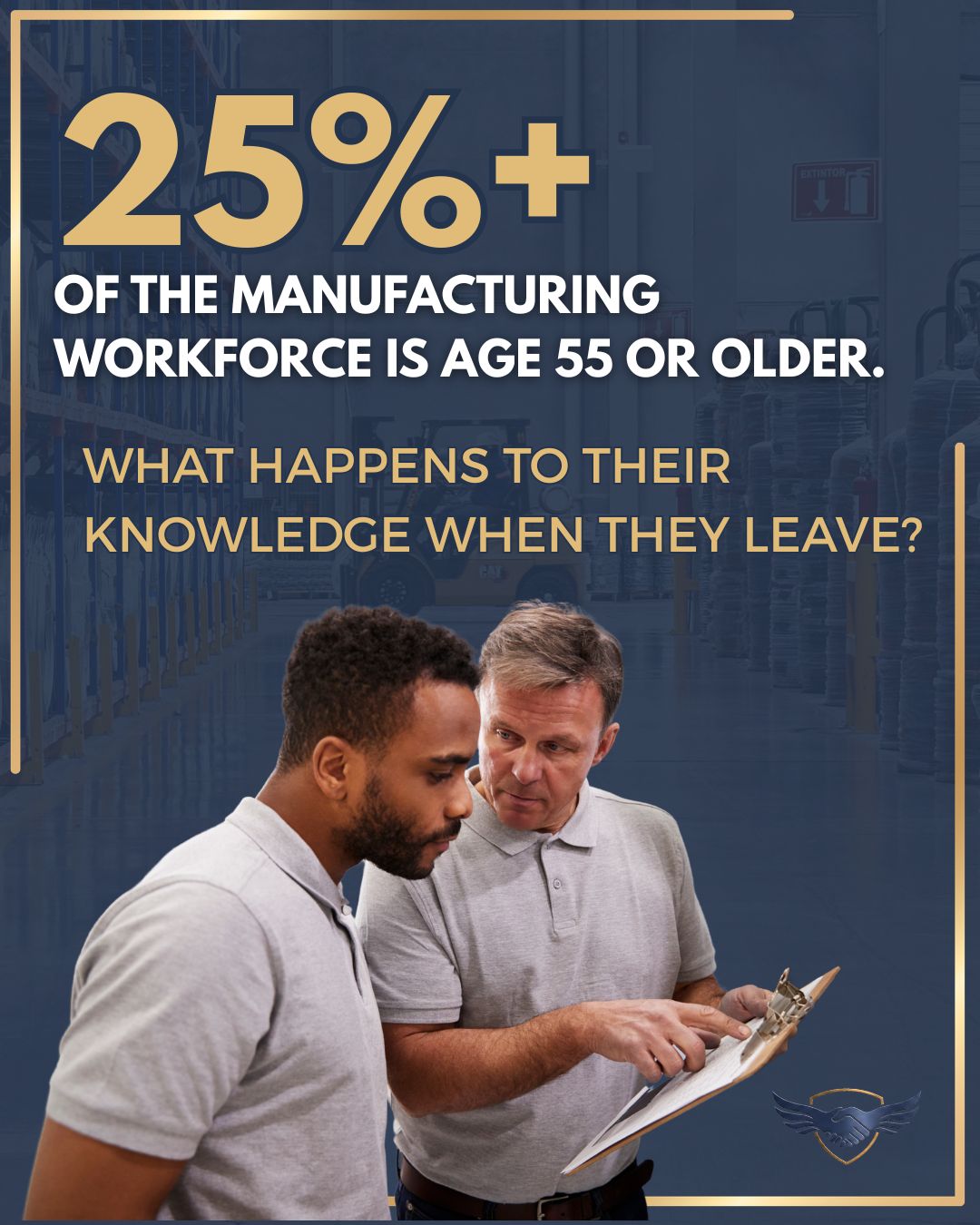
This is More Than A Retirement Problem.
When experienced leaders leave without a system for transferring their knowledge, organizations lose more than employees. They lose judgment, relationships, cultural insight, and years of hard-earned expertise.
The result is four interconnected risks that can affect the entire organization:
Intellectual Capital Loss:
Critical knowledge often lives in people—not processes. When experienced leaders retire, undocumented expertise, problem-solving instincts, and operational insight can walk out with them.
Leadership Pipeline Gaps:
Without a prepared bench, organizations are forced to promote people before they are ready or leave critical roles unfilled—putting performance, culture, and retention at risk.
Generational Disconnect:
Emerging leaders bring valuable strengths and new perspectives, but differing expectations around communication, development, flexibility, and leadership can create friction without intentional alignment.
Performance Inconsistency:
When knowledge transfer, accountability, and leadership development depend on individual managers, results vary across departments, shifts, and generations.
These Challenges Are Interconnected. The Solution Must Be Too.
Leadership Training Isn't Enough.
You Need A System.
The challenges facing manufacturers are too interconnected to be solved through isolated workshops, one-time training events, or succession plans that remain on paper.
The PRACTICE Framework is a comprehensive Leadership Business Operating System built to strengthen performance today while preparing the organization for tomorrow. Its eight interconnected pillars create a repeatable structure for developing leaders, transferring knowledge, aligning generations, and sustaining excellence beyond any one person

PRACTICE stands for:
Productivity: Establish clear measures and a consistent Develop-Deploy-Coach rhythm.
Responsibility: Create role clarity, ownership, and sustainable momentum.
Accountability: Connect strategic priorities to daily execution.
Communication Channels: Improve information flow, meeting discipline, and organizational alignment.
Teamwork: Strengthen collaboration, behavioral awareness, and psychological safety.
Innovation: Capture ideas systematically and build organizational adaptability.
Continuity: Preserve critical knowledge, create redundancy, and prepare leadership successors.
Empowerment: Develop people through mentorship, delegation, and structured opportunities to grow.
PRACTICE transforms leadership development from an occasional event into the way your organization operates.
Why PRACTICE Works Where Traditional Training Falls Short
Engages Experienced Leaders
Current leaders become co-creators of the system, giving them an active role in transferring knowledge, shaping expectations, and preparing those who will follow.
Creates Clear Development Pathways
Emerging leaders receive progressive opportunities to learn, lead, receive feedback, and grow—rather than being promoted before they are prepared.
Embeds Knowledge into the Orgaization
Critical expertise is transferred through coaching rhythms, shared practices, documented systems, and intentional leadership redundancy.
Aligns Leadership With Performance
Development is connected to real responsibilities, measurable commitments, and daily execution—not separated from the work leaders are expected to perform.
Builds Capacity that Multiplies
Senior leaders develop mid-level leaders. Mid-level leaders develop their teams. Over time, leadership development becomes an internal capability rather than an ongoing external dependency.
The goal is not simply to develop better leaders.
It is to build an organization that continually develops its own leaders.
A Leadership System Built to Last
PRACTICE is implemented through four progressive phases. Each phase builds the leadership capacity required for the next—moving from individual development to organizational continuity and succession readiness.

Phase 1:
Leadership Foundations
Who you are as a leader
Leaders build the self-awareness, emotional intelligence, and coaching habits needed to lead themselves and others effectively.
Key focus:
DISC, EQ-i 2.0, high-performance coaching, and a personal Leadership Rule of 5.

Phase 2:
Leadership Influences
How You Lead Others
Leaders apply the PRACTICE Framework and strengthen five essential influences: Vision, Connection, Trust, Sustainability, and Legacy.
Key focus:
Develop–Deploy–Coach rhythms, team alignment, accountability, and cascade coaching.

Phase 3:
Leadership Sustainability
How The Culture Continues
Leadership practices move beyond individual ability and become part of the organization’s culture, systems, and daily operations.
Key focus:
Organizational alignment, momentum, continuity systems, and successor identification.

Phase 4:
Leadership Legacy
What You Leaved Behind
Senior leaders intentionally prepare designated successors through assessment, real-world leadership assignments, structured coaching, and documented readiness.
Key focus:
Position coverage, successor development, leadership deployment, and succession readiness.
Each phase lasts approximately 90 days and builds upon the one before it—creating a development system that strengthens leaders, preserves knowledge, and prepares the organization for what comes next.
What This System Produces
The result is more than stronger individual leaders. It is an organization prepared to sustain its knowledge, culture, and performance through every leadership transition.
Position Coverage
Critical roles have identified and intentionally developed successors prepared to step forward.
Knowledge Continutiy
Operational expertise, sound judgment, and institutional knowledge are transferred before they leave the organization.
Stronger Performance
Shared expectations, accountability rhythms, and leadership practices create greater consistency across teams and departments.
Internal Coaching Capacity
Senior and mid-level leaders develop the skills and structure to continually coach the people around them.
Higher Retention
Employees are more likely to stay when they can see a clear path for growth and experience meaningful investment in their development.
Organizational Independence
Leadership development becomes an internal capability—not something dependent on one leader, one cohort, or continuous outside support.
Build leaders who build leaders
and an organization capable of carrying its success forward.
Building leaders who build leaders.
Meet Dr. Gary White
Dr. Gary White helps organizations move beyond one-time leadership training and build systems that strengthen performance, develop people, and preserve what matters most.
Through decades of leadership, coaching, and organizational development experience, Gary has seen what happens when leadership depends too heavily on a few key individuals. He developed the PRACTICE Framework to give organizations a practical, repeatable way to transfer knowledge, align teams, prepare successors, and create leadership capacity at every level.
His approach combines proven leadership principles with real-world application. Leaders do not simply learn new concepts. They make specific commitments, apply them in their daily work, coach others, and build systems that continue long after the engagement ends.
Is Your Organization Ready for the Leadership Transition?
The strongest time to prepare for a leadership departure is before the position becomes vacant.
A Leadership Risk Assessment helps uncover where your organization may be vulnerable, including knowledge concentrated in too few people, underdeveloped successors, inconsistent leadership practices, and gaps in continuity planning.
Schedule a discovery call with Dr. Gary White to discuss your organization’s current leadership challenges and explore how the PRACTICE Framework can support a customized path forward.